Every organization we talk to has AI activity underway.
Pilots. Copilots. A model someone stood up. A mandate from the board.
Movement is everywhere.
But movement isn’t performance.
In our last post, we wrote about the “connective tissue” problem: how execution often breaks down not inside the individual parts, but in the connections between them, the thing that rarely gets named or owned.
AI doesn’t fix that problem. It runs straight into it, faster, and more expensively.
The same things that stall execution everywhere else — unclear priorities, misaligned governance, weak accountability — tend to produce the same failures in AI investments. Pilots that never scale. Spend that doesn’t connect to outcomes. Tools adopted unevenly, if at all.
Some of those failures just waste money. Others quietly create exposure: decisions, data, and commitments moving faster than anyone’s governing them.
Which leads somewhere that surprises people:
Most organizations don’t have an AI problem. They have a performance system that isn’t built to make AI perform.
So the first question isn’t “which model” or “which tool.” It’s whether the structural conditions exist to make the investment actually perform, across strategy, governance, execution, and value.
That’s an organizational performance question. Not a technology audit.
This is the work we do. We’ve written and implemented the AI strategies, coordination models, and performance metrics for enterprise IT leaders whose organizations are now running AI across multiple departments. The same gaps show up again and again.
So we built a way for leaders to answer it, honestly, and for themselves.
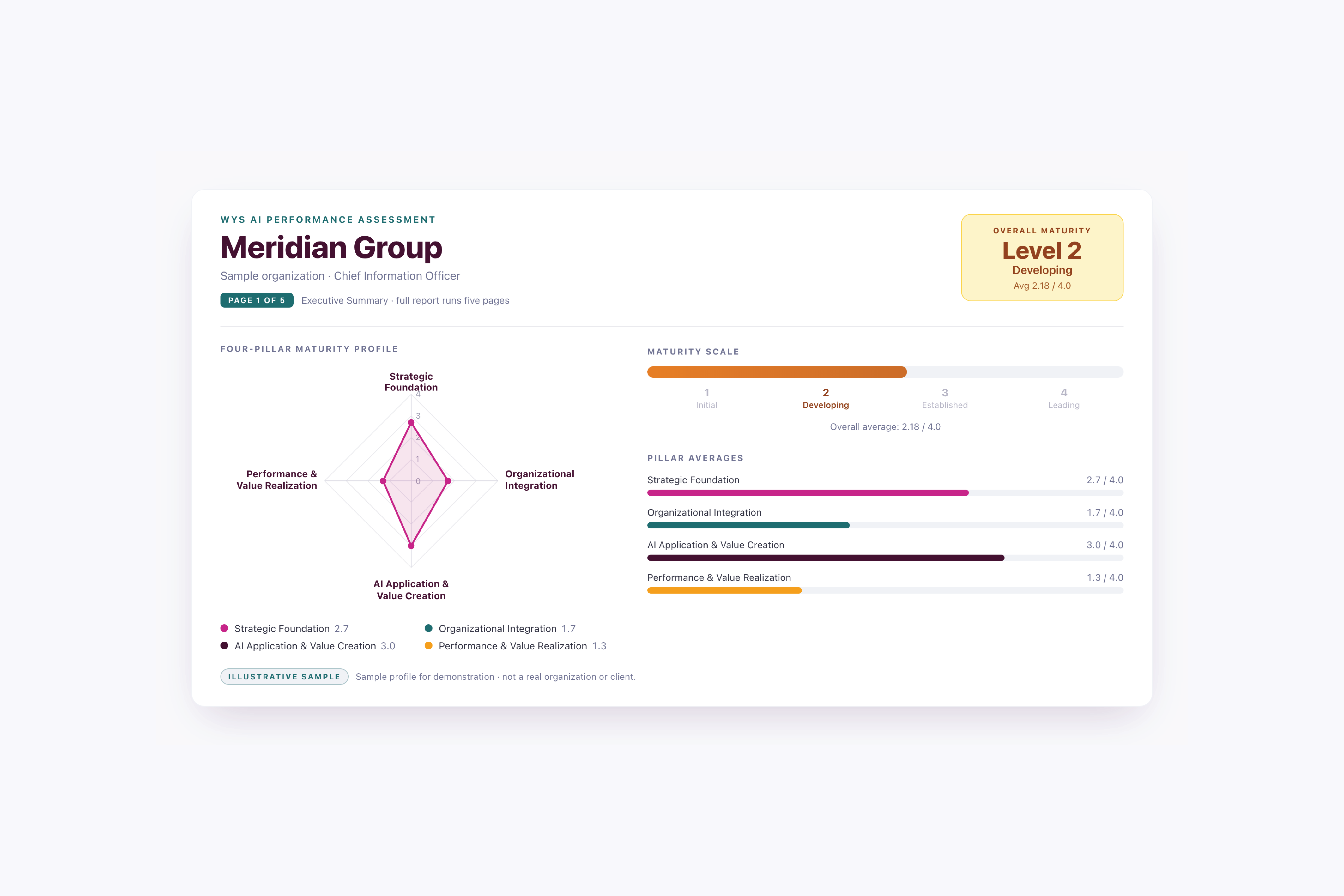
The AI Performance Assessment is a structured, self-paced read that scores how your organization actually operates, and delivers your report the moment you finish.
The framework beneath it is the point: four pillars of AI performance, eleven dimensions beneath them, and a maturity model that places your organization from ad hoc to leading. Every score comes from your answers, a read on how you actually operate, where you’re strong, and where you’re most exposed.
It’s worth having a few of your leaders take it independently. Where their reads diverge is often the most useful signal of all.
If you want to go further, an advisor will walk through it with you and help turn the gaps into a plan. But the value doesn’t wait on that conversation.
And it’s a demonstration in itself: AI applied to a real decision, producing something useful and specific to your organization, not impressive in the abstract.
If AI is in your building, it’s worth knowing how well it’s actually working.
See how your organization actually performs.
The assessment takes 15 to 45 minutes, it’s free, and your report is delivered the moment you finish — four pillars, eleven dimensions, and an honest maturity read from ad hoc to leading.